


Marriage is an important legal and personal relationship, but sometimes circumstances make it difficult for two people to continue living together. Differences in expectations, financial disagreements, family conflicts, lack of communication, and serious personal issues can create situations in which separation becomes the most practical option. When a married couple decides to end their relationship legally, understanding the available legal options becomes essential. The process involves more than simply deciding to separate because the marriage must also be formally dissolved according to applicable laws.
In India, divorce is governed by different personal laws depending on the religion and legal framework applicable to the marriage. The Hindu Marriage Act, 1955, the Special Marriage Act, 1954, and other relevant personal laws provide different provisions for ending a marriage. The divorce procedure generally falls into two main categories: mutual consent divorce and contested divorce. Both involve legal requirements, documentation, and court proceedings, but their complexity and expected duration can vary considerably. Understanding these differences can help individuals make informed decisions and avoid unnecessary complications.
This guide explains the major stages of divorce in India, the documents generally required, important legal considerations, court proceedings, financial responsibilities, and the rights of both spouses.
Understanding the Legal Framework of Divorce in India
Before starting the legal process, it is important to understand which law applies to a particular marriage. India does not follow one universal divorce law for every citizen. Instead, different marriage laws establish the grounds, conditions, and procedures through which a marriage can be legally dissolved. For example, the Hindu Marriage Act applies to eligible Hindu, Buddhist, Jain, and Sikh marriages, while the Special Marriage Act provides a framework for civil marriages registered under that legislation.
The legal framework determines whether spouses can seek divorce through mutual consent or need to establish legally recognized grounds before a court. Depending on the applicable law, grounds may include cruelty, desertion, adultery, conversion, certain mental health-related circumstances, and other statutory conditions. Not every ground applies identically under every personal law, so individuals should avoid assuming that the same requirements govern all marriages.
Another important consideration is that divorce proceedings are generally handled by the appropriate family court or other competent court, depending on the location and applicable legislation. The court examines the petition, relevant evidence, legal requirements, and any agreements between the spouses before passing a final decree.
Types of Divorce Available Under Indian Law
Indian law provides different ways to dissolve a marriage depending on whether both spouses agree to the separation. The circumstances surrounding the relationship, the willingness of each spouse to cooperate, and the existence of unresolved disputes can influence which option is appropriate.
Mutual Consent Divorce
Mutual consent divorce is generally considered a more straightforward option when both spouses agree that they cannot continue their marriage. Under Section 13B of the Hindu Marriage Act, eligible couples can jointly approach the court after living separately for at least one year, subject to the statutory requirements. Section 28 of the Special Marriage Act contains a corresponding provision for marriages governed by that legislation.
In this arrangement, both spouses agree to seek a legal separation and generally settle important matters such as maintenance, child custody, visitation, and the division or settlement of financial responsibilities. They submit a joint petition explaining that they have been living separately, have been unable to live together, and have mutually agreed to dissolve their marriage.
The court examines whether the consent is genuine and whether the statutory conditions are satisfied. Although the law generally provides for a second motion after a specified interval, the Supreme Court has clarified that the six-month waiting period can be waived in appropriate cases. Waiver is not automatic, and the court considers the circumstances before granting it.
Contested Divorce
A contested divorce becomes necessary when one spouse wants to end the marriage but the other spouse does not agree, or when the parties cannot resolve the legal issues surrounding separation. In such cases, the spouse filing the petition must rely on a legally recognized ground available under the applicable marriage law.
Unlike mutual consent proceedings, contested cases may involve detailed pleadings, evidence, witness statements, cross-examination, and several court hearings. For instance, if a person files for divorce on the ground of cruelty, the court must examine the circumstances and evidence presented rather than simply accepting the allegation.
The process may take considerably longer when the spouses disagree about the facts, financial arrangements, or parenting responsibilities. Each party has an opportunity to present their legal position, and the court makes a decision based on the applicable law and available evidence.
Step-by-Step Divorce Procedure in India
Although the exact requirements depend on the applicable marriage law, most divorce cases follow a series of legal stages. Understanding these stages helps spouses prepare documents, understand their responsibilities, and avoid delays caused by incomplete applications or unresolved disputes.
1. Consulting a Divorce Lawyer
The first practical step is to understand the legal position of the marriage. A person considering divorce should consult a qualified family lawyer who can explain the applicable legislation, available grounds, financial rights, and possible legal consequences. During the initial consultation, the lawyer generally reviews the marriage details, separation history, family circumstances, and any existing disputes.
Legal advice is particularly useful when children, jointly owned property, loans, domestic violence allegations, or financial dependency are involved. For example, a spouse who has been financially dependent on the other may need to understand the possibility of claiming maintenance. Similarly, parents should consider how custody and visitation arrangements could affect their children.
2. Preparing the Divorce Petition
Once the appropriate legal option has been identified, the next stage involves preparing the petition. In a mutual consent case, both spouses generally participate in preparing and signing a joint petition. In a contested case, the spouse seeking divorce files an individual petition explaining the legally recognized grounds and relevant circumstances.
The petition usually contains details about the marriage, the parties, their residential addresses, the date of separation where relevant, information about children, and the relief being requested. In contested proceedings, allegations must be presented carefully and supported by relevant facts. A petition should not contain exaggerated or unsupported claims because inaccurate statements can complicate the case.
3. Filing the Petition in the Appropriate Court
After preparation, the petition is submitted to the court having jurisdiction over the matter. Under the Hindu Marriage Act, Section 19 explains where a petition may be presented. Depending on the circumstances, jurisdiction may be connected to the place where the marriage was solemnized, where the respondent resides, where the parties last lived together, or other statutory conditions.
The court registry examines the filing to determine whether the necessary documents, prescribed forms, signatures, and court fees have been provided. If there are defects, the applicant may be asked to correct them before the matter proceeds. Once the petition is accepted and registered, the court assigns a case number and schedules the next stage.
4. Court Appearance and Mediation
In many matrimonial disputes, the court may encourage reconciliation or refer the parties to mediation. The purpose is to determine whether the disagreement can be resolved without continuing lengthy litigation. Mediation provides a relatively private environment in which spouses can discuss financial responsibilities, parenting arrangements, and other unresolved matters with the assistance of a neutral mediator.
Mediation does not mean that either spouse must agree to continue the marriage. If reconciliation is not possible, the proceedings can continue according to law. In mutual consent cases, the court also examines whether both parties have made their decision voluntarily and understand the consequences of the settlement.
5. Evidence and Legal Arguments
Evidence becomes especially important in contested divorce proceedings. Both parties may submit relevant documents, statements, and other legally admissible material to support their positions. Depending on the allegations, evidence may include communication records, financial documents, medical records, witness testimony, and other information relevant to the issues before the court.
The opposing party may respond to the allegations and challenge the evidence. Hearings can involve examination and cross-examination of witnesses, legal arguments, and consideration of interim applications. This stage may take considerable time when the facts are disputed or the parties have several related legal issues.
6. Final Hearing and Divorce Decree
After examining the pleadings, evidence, and arguments, the court decides whether the legal requirements for divorce have been satisfied. If the court finds sufficient grounds under the applicable law, it may grant a divorce decree. In a mutual consent matter, the court verifies the agreement, consent, and statutory conditions before passing its order.
The divorce becomes legally effective through the court’s decree rather than merely because the spouses have started living separately. Both parties should obtain and preserve an official copy of the final judgment or decree. This document may be needed for future marriage-related formalities, financial records, property matters, and other legal requirements.
Documents Required for Divorce in India
Proper documentation helps prevent unnecessary delays during court proceedings. The exact list varies according to the court, applicable personal law, and individual circumstances. However, applicants are commonly asked to provide documents establishing the marriage, identity, residence, and relevant financial or family information.
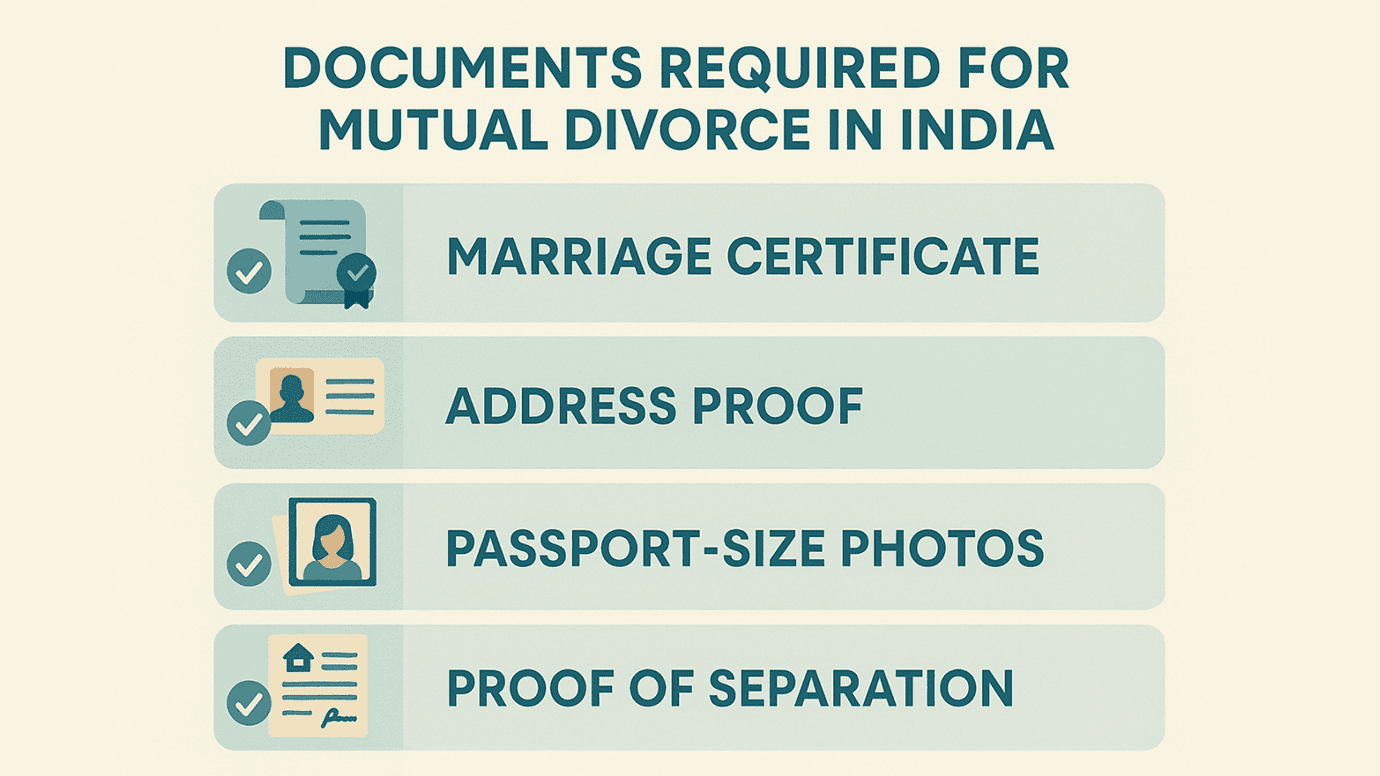
Some commonly required documents include:
-
Marriage certificate or other acceptable proof of marriage.
-
Identity and residential address documents of both spouses, where available.
-
Recent photographs and details of the marriage.
-
Information and documents relating to children, if applicable.
-
Financial records, income details, and evidence relevant to maintenance or property disputes.
In contested cases, additional supporting evidence may be necessary depending on the grounds mentioned in the petition. For example, financial statements may become important when maintenance is disputed, while communication records may be relevant when specific allegations need to be examined. Individuals should maintain original documents safely and provide copies as required by their lawyer or the court.
Comparison Between Mutual Consent and Contested Divorce
Choosing the appropriate legal route depends on the relationship between the spouses, their willingness to cooperate, and the issues that remain unresolved.
| Basis of comparison | Mutual consent divorce | Contested divorce |
|---|---|---|
| Agreement | Both spouses agree | One or both parties disagree |
| Petition | Joint petition | Petition by one spouse |
| Legal grounds | Statutory mutual consent requirements | Legally recognized grounds |
| Proceedings | Generally simpler | Usually more detailed |
| Evidence | Mainly documents and settlement details | Evidence and witness examination may be required |
| Duration | Often shorter | Can take considerably longer |
| Expenses | Generally more predictable | May increase with prolonged litigation |
Neither option guarantees a particular result or timeline. The court must follow the applicable legal requirements, and individual circumstances can significantly affect the proceedings.
Maintenance, Alimony, and Financial Rights During Divorce
Financial arrangements are among the most important aspects of matrimonial separation. When one spouse earns significantly more than the other, the financially dependent spouse may be entitled to seek maintenance or other appropriate financial relief under the applicable law. The court may consider income, assets, reasonable expenses, financial needs, earning capacity, liabilities, and the circumstances of both parties.
Under the Hindu Marriage Act, Sections 24 and 25 address maintenance during proceedings and permanent alimony. Other personal laws and applicable legislation also contain provisions concerning maintenance. The amount is not automatically fixed or identical in every case. Courts examine the available financial information and individual circumstances before deciding an appropriate amount.
Property-related disputes require separate attention. A settlement should clearly identify jointly owned assets, outstanding loans, financial obligations, jewellery, and other relevant property interests. Spouses should avoid relying entirely on verbal promises when important financial arrangements are involved. Written agreements and court-approved settlements can help reduce future misunderstandings.
Child Custody and Visitation Rights After Divorce
When a married couple has children, their welfare becomes a major consideration during divorce proceedings. Courts generally prioritize the child’s best interests rather than treating custody as an automatic entitlement of either parent. Factors such as the child’s age, education, emotional needs, safety, living arrangements, and the ability of each parent to provide appropriate care may be considered.

Custody arrangements can take different forms, including physical custody, joint arrangements, and visitation rights, depending on the circumstances and applicable law. One parent may have primary physical custody while the other receives reasonable opportunities to maintain contact with the child. Financial support for education, healthcare, and everyday expenses should also be addressed clearly.
Parents should understand that disagreements about custody do not necessarily prevent the marriage from being legally dissolved. However, unresolved parenting issues may require additional hearings or judicial decisions. A child-focused agreement can help create stability and reduce the emotional impact of parental separation.
How Long Does the Divorce Procedure Take in India?
The time required to complete a divorce depends on the type of case, the applicable law, the court’s workload, and the cooperation of both spouses. Mutual consent cases are generally completed faster because the parties have already agreed on ending the marriage and resolving major disputes. Under the Hindu Marriage Act, the second motion is ordinarily made after six months but before eighteen months from the filing of the first petition. However, courts can waive the six-month waiting period in appropriate circumstances. The Supreme Court explained the relevant considerations in Amardeep Singh v. Harveen Kaur (2017).
Contested divorce cases can take considerably longer because the court may need to examine allegations, consider documentary evidence, hear witnesses, and resolve interim applications. Adjournments, unavailable witnesses, complicated financial disputes, and appeals can also affect the overall timeline. Therefore, it is not advisable to rely on a fixed number of months or years when planning a separation. A lawyer familiar with the local family court can provide a more realistic estimate after reviewing the circumstances.
Important Legal Rights of Both Spouses
Both husband and wife have legal rights during divorce proceedings. These rights are intended to ensure that the process is fair and that neither party is unfairly disadvantaged because of financial circumstances, personal disagreements, or unequal access to legal assistance. Each spouse has the opportunity to present their position, respond to allegations, and seek appropriate relief under the applicable legislation.
Some important considerations include the right to seek maintenance where legally justified, the right to participate in child custody proceedings, the right to present relevant evidence, and the right to challenge an adverse decision through available legal remedies. Spouses may also seek interim relief when immediate financial or family-related protection is necessary.
Individuals should remember that filing for divorce does not automatically remove every legal responsibility towards the other spouse or children. Financial support, parenting responsibilities, and court-ordered obligations may continue even after the marriage has ended. Understanding these responsibilities can help both parties avoid unnecessary legal disputes.
Common Mistakes to Avoid During Divorce Proceedings
Divorce can involve emotional pressure, financial uncertainty, and complicated family decisions. As a result, people sometimes make mistakes that create additional legal difficulties. Careful preparation and informed decision-making can make the experience more manageable.
Some common mistakes include:
-
Signing settlement documents without understanding their legal consequences.
-
Hiding income, assets, or important financial information.
-
Ignoring court notices or missing scheduled hearings.
-
Making false allegations or submitting misleading evidence.
-
Using children as a way to pressure the other parent during disputes.
Another important mistake is assuming that an informal separation automatically ends a marriage. Even if spouses have lived separately for several years, their marriage generally remains legally valid until it is dissolved through an appropriate legal process. Obtaining proper legal advice and maintaining accurate records can prevent misunderstandings.
Conclusion
Understanding the divorce procedure is essential for anyone considering the legal dissolution of marriage in India. Whether spouses choose mutual consent or one party needs to pursue a contested case, the process requires compliance with applicable marriage laws, appropriate documentation, and court approval. Important matters such as maintenance, property arrangements, child custody, and financial responsibilities should receive proper attention before a final settlement is reached.
Every matrimonial situation is different, so there is no single approach that works for everyone. Some couples may complete their separation through a mutually agreed settlement, while others may need judicial intervention to resolve serious disagreements. Taking informed decisions, communicating responsibly, and obtaining guidance from a qualified family lawyer can help reduce unnecessary complications. Ultimately, a clear understanding of legal rights and responsibilities allows individuals to approach this important life transition with greater confidence and prepare for a more stable future.